【ANN NEWS, LOS ANGELES】
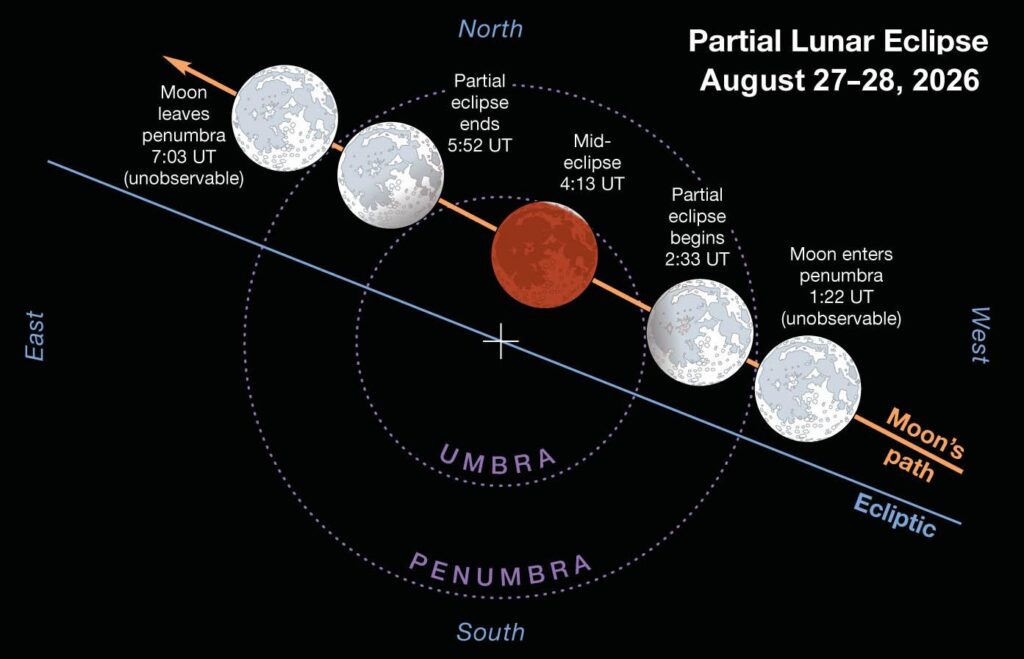
Don’t forget to look up at the sky tonight! A spectacular deep partial lunar eclipse, approaching a total lunar eclipse, will unfold across the North American night sky from the evening of August 27 into the early hours of August 28.
The National Aeronautics and Space Administration(NASA)said the eclipse will be visible across North America, South America, and parts of Europe and Africa. At maximum eclipse, about 96% of the moon’s surface will enter the deepest part of Earth’s shadow, known as the umbra, leaving only a small portion not completely covered.
Although this is not technically a total lunar eclipse, the vast majority of the moon will enter Earth’s umbra, creating a visual effect very similar to a total lunar eclipse.
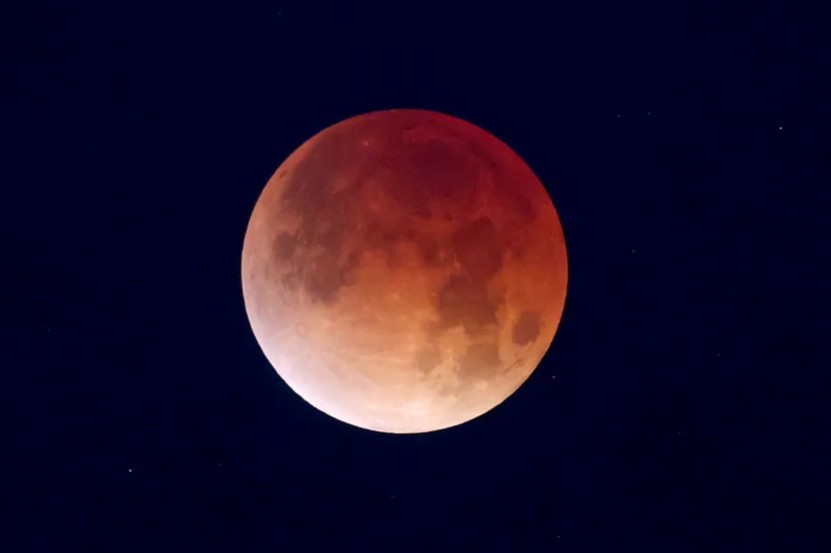
Even more strikingly, the portion of the moon inside Earth’s shadow may appear dark red, copper-red or orange-red, earning it the popular nickname “blood moon” among many astronomy enthusiasts.
What Is the Best Time to Watch in Los Angeles Tonight?
For Southern California residents, the timing of this celestial spectacle is especially convenient, with no need to stay up until the middle of the night.
According to data released by NASA, the eclipse will reach maximum eclipse at about 9:13 p.m. Pacific Time tonight.
Key times for the eclipse in the Los Angeles area are approximately:
Around 7:34 p.m.: The noticeable partial lunar eclipse phase begins
Around 9:13 p.m.: Maximum eclipse, with about 96% of the moon’s surface entering Earth’s umbra
Around 10:52 p.m.: The partial lunar eclipse phase ends
Around 12:01 a.m.: The penumbral eclipse ends completely
For residents of Los Angeles and Southern California, around 8:30 p.m. to 9:30 p.m. tonight will therefore be an especially worthwhile viewing period, with around 9:13 p.m. being the moment not to miss.
Why Does the Moon Turn Red?
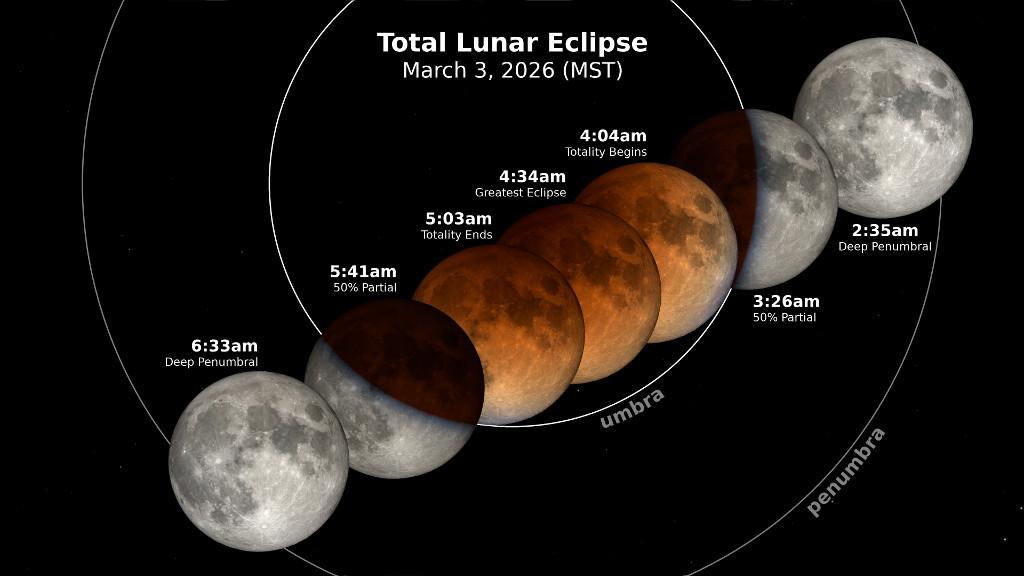
During a lunar eclipse, the sun, Earth and moon move into nearly a straight line, with Earth positioned between the sun and the moon, causing Earth’s shadow to fall across the lunar surface.
However, the moon does not completely “disappear.”
As sunlight passes through Earth’s atmosphere, shorter wavelengths such as blue light are more easily scattered, while longer wavelengths such as red and orange light can continue to reach the moon after being refracted through Earth’s atmosphere.
As a result, the portion of the moon inside Earth’s umbra may appear copper-red, dark red or even orange-red.
This is where the name “blood moon” comes from.
No Special Glasses Needed
Unlike a solar eclipse, viewing a lunar eclipse does not require eclipse glasses.
As long as the skies are clear, it can be safely viewed with the naked eye. Binoculars or a small telescope can provide a clearer view of Earth’s shadow gradually moving across the lunar surface.
The eclipse can also be viewed from within the city, but for better viewing and photography, observers can choose a location with less artificial light and a relatively unobstructed view toward the southeast.
Griffith Observatory Open for Eclipse Viewing Tonight
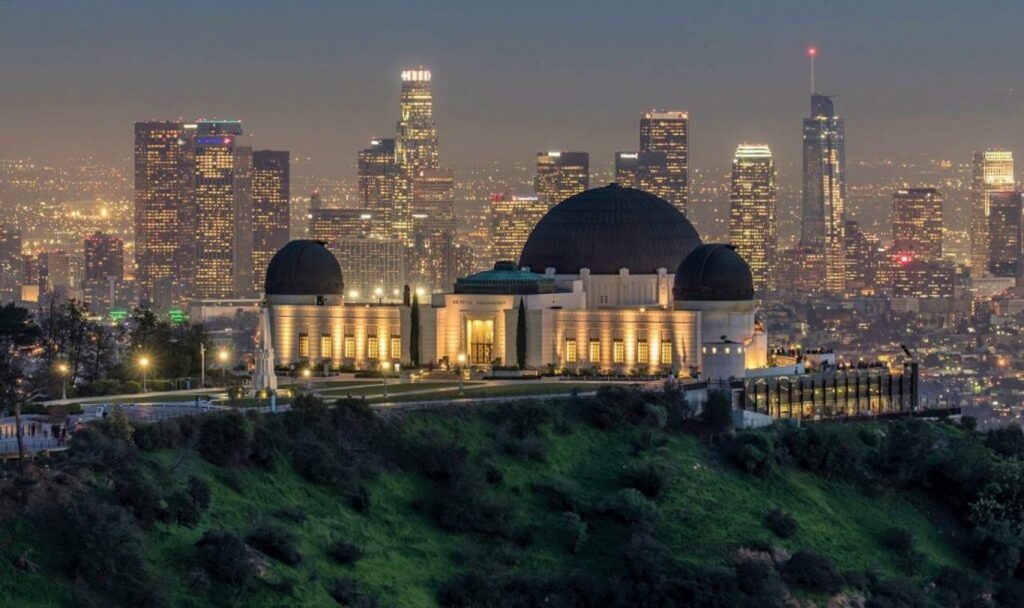
Los Angeles’ renowned Griffith Observatory will also hold a special lunar eclipse viewing event tonight.
The observatory said its outdoor areas will be open to the public for eclipse viewing from 7:25 p.m. to 11 p.m. tonight, while an online livestream will run from 7:25 p.m. to 12:05 a.m., weather permitting.
The observatory cautioned that large crowds are expected tonight, with very limited parking and potentially severe traffic congestion on surrounding roads.
For Southern California residents who do not want to travel to the observatory, the eclipse can also be viewed from a backyard, balcony or any outdoor location with an unobstructed view.
NASA said the August 27-28 partial lunar eclipse will be one of the major astronomical viewing events of 2026.
If Southern California weather cooperates tonight, remember one key time:
Around 9:13 p.m.
Look up at the night sky then, and a copper-red full moon almost entirely immersed in Earth’s shadow will offer one of the most anticipated celestial spectacles of this summer night.